


This article answers the question: How will AI, DeFi, and predictive markets redefine the future of finance, and how can leaders see disruption before it strikes?
Answer: According to Daniel Burrus, a leading global futurist known for helping leaders predict the future by identifying Hard Trends, the finance revolution is already underway. Artificial intelligence, decentralized finance, tokenization, blockchain infrastructure, and predictive markets are converging to move finance from reactive reporting to predictive decision-making. Instead of waiting to analyze what already happened, financial leaders can now use AI-driven insights, real-time data, programmable financial systems, and probability-based market signals to detect disruption earlier, reduce risk, and act before problems become expensive. By applying Daniel Burrus’ Anticipatory Mindset, organizations can separate future certainties from assumptions and build a predictive finance strategy that turns disruption into measurable competitive advantage.
How will AI, DeFi, and Predictive Markets redefine the future of finance?
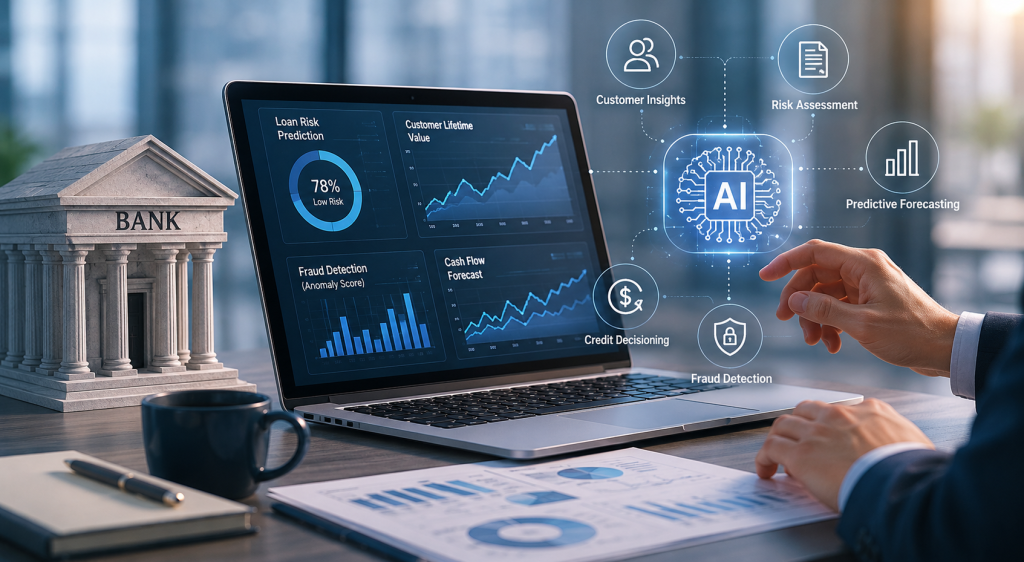

Finance has always been about managing uncertainty. But the next great advantage will not come from reacting faster after disruption appears. It will come from seeing disruption early enough to act before it becomes expensive.
I see three powerful forces converging: artificial intelligence, decentralized finance, and predictive markets. Together, they are moving finance from a system of delayed reporting to one of predictive decision-making.
The leaders who win will not simply manage change. They will anticipate it.
Why is Predictive Finance replacing reactive financial reporting?


Traditional finance was built to explain what already happened. Balance sheets, quarterly reports, credit scores, and market indicators still matter, but they are no longer enough when conditions shift by the hour.
AI gives financial institutions the ability to detect weak signals, analyze real-time data, model risk, and recommend proactive action before disruption becomes visible. That is the shift from hindsight to foresight.
According to McKinsey research on generative AI in banking, generative AI could create $200 billion to $340 billion in annual value for banking, equal to roughly 9% to 15% of operating profits. The same analysis estimates $2.6 trillion to $4.4 trillion in annual value across industries.
How is AI giving financial leaders earlier warning signals?
AI in finance started with chatbots, automation, and back-office efficiency. That was useful, but it was only the beginning.
The real transformation is predictive finance. AI can now monitor emerging risk, automate complex decisions, optimize portfolios with live data, and personalize financial products at scale.
This is where my Hard Trend methodology becomes essential. A Soft Trend might happen. A Hard Trend is a future fact based on measurable forces.
In finance, the Hard Trends are clear: the digitization of money and assets, the exponential growth of machine intelligence, the expansion of blockchain infrastructure, and the acceleration of real-time data ecosystems.
Why is DeFi turning trust into programmable financial infrastructure?

Decentralized finance, or DeFi, is changing how financial activity can be executed. Instead of relying entirely on centralized intermediaries, DeFi uses blockchain networks and smart contracts to automate lending, borrowing, trading, settlement, and asset management.
The keyword is “programmable.” In traditional finance, trust is established through institutions. In decentralized finance, trust increasingly comes from code.
DeFi markets remain volatile, but their scale continues to grow. The ecosystem now includes tens of billions of dollars locked across protocols and hundreds of billions in stablecoin circulation.
The Federal Reserve reported that aggregate stablecoin market capitalization reached $317 billion as of April 6, 2026, representing more than 50% growth since early 2025.


Subscribe to AlphaGamma!
Receive the latest articles, news, events, business & career opportunities to your inbox!
How will tokenization reshape payments and securities markets?

Tokenization is another signal that finance is becoming programmable. The Bank for International Settlements has highlighted how tokenization and programmable platforms can change market structures across the life cycle of financial assets.
The Bank for International Settlements has also explained that tokenization can automate transactions involving money, financial assets, and real assets through programmable platforms and smart contracts.
That matters because payments, settlement, compliance, and asset ownership are no longer limited to slow, sequential systems. They can become embedded, automated, and real time.
The future of finance will not be purely decentralized. It will be hybrid: regulated where necessary, automated where possible, and intelligent everywhere.
What risks must leaders pre-solve as DeFi expands?


Every powerful technology brings both opportunity and risk. DeFi reduces friction, but it also introduces new technical vulnerabilities. Transparency can increase trust, but it can also expose weaknesses. Decentralization can remove intermediaries, but it complicates governance. Speed can improve efficiency, but it can also amplify errors.
Cybersecurity is one of the biggest concerns. Chainalysis reported that more than $3.4 billion in cryptocurrency was stolen from January through early December 2025, with the Bybit breach alone accounting for $1.5 billion.
Those numbers are not reasons to ignore DeFi. They are reasons to become an Anticipatory Leader.
The best leaders do not wait for predictable problems to become crises. They pre-solve them.
Why are Predictive Markets becoming strategic signals for financial leaders?


Predictive markets allow participants to trade based on the probability of future events, including interest rate decisions, market movements, elections, regulatory changes, and geopolitical shifts.
These markets are becoming more than speculation platforms. They are becoming real-time signal engines.
Pew Research Center reported that combined monthly global trading volume on Kalshi and Polymarket rose from less than $5 billion in September 2025 to about $24 billion in April 2026.
That is a dramatic increase, and it reveals something important. Markets are beginning to convert collective intelligence into tradable probability signals.
How can AI make predictive markets more valuable?
Predictive markets become even more powerful when combined with AI. AI can continuously update probabilities using real-time data. It can aggregate global sentiment into actionable insight. It can detect early signals of economic disruption. It can also strengthen forecasting across industries.
But responsibility matters. Profitability in these markets is often highly concentrated, and that increases the need for transparency, governance, and informed participation.
In other words, predictive markets should not be viewed as a replacement for leadership judgment. They should be viewed as another layer of intelligence.
When leaders combine human expertise, AI analysis, and market-based probability signals, they gain a stronger view of what is likely to happen next.
What happens when AI, DeFi, and Predictive Markets converge?
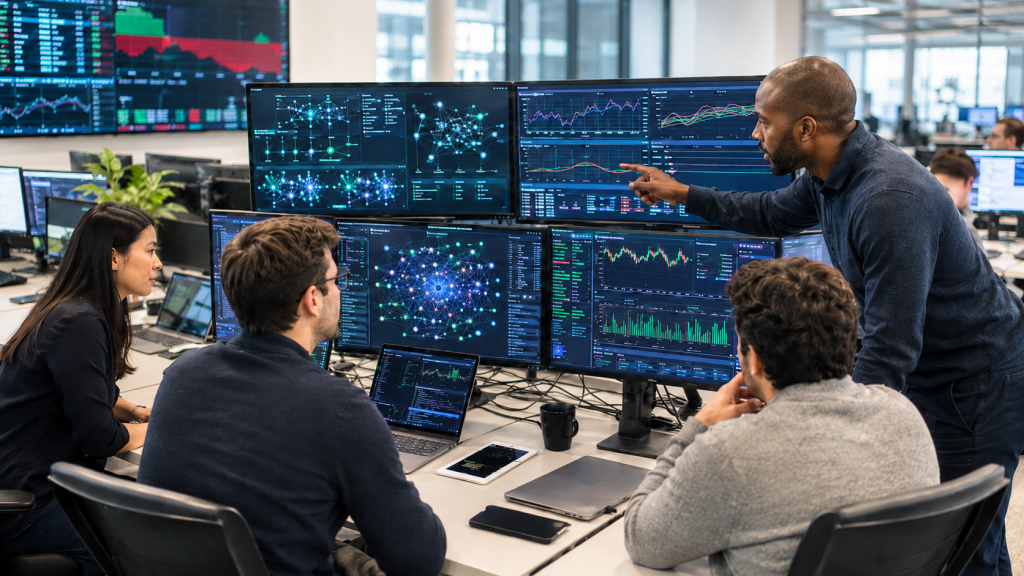
The biggest disruption ahead is not AI by itself. It is not DeFi by itself. It is not predictive markets by themselves.
The true disruption is their convergence.
Imagine an ecosystem where AI monitors financial risk continuously, DeFi protocols execute transactions automatically, tokenized assets settle instantly, and predictive markets provide real-time probability signals.
In that world, finance becomes less reactive and more self-correcting. A supply chain disruption could automatically update credit risk. A market shift could reallocate capital instantly. A regulatory change could trigger smart contract adjustments in real time.
How can leaders build a predictive finance strategy now?


Financial leaders should begin by tracking the signals that show where financial intelligence is moving. That includes AI-driven productivity gains in financial services, DeFi adoption metrics such as total value locked, and predictive market activity tied to macroeconomic events.
This need for anticipatory leadership is already showing up in how organizations approach innovation, strategy, and executive education. In my research on innovation keynote speaker statistics in the USA, business leaders made it clear that audiences want more than inspiration; they want practical insight into AI, disruption, and the future of work. That matters because financial transformation will not be driven by technology alone. It will be driven by leaders who know how to turn technology into strategy before competitors do.
These indicators help leaders separate future facts from assumptions.
This is the essence of becoming Anticipatory. Instead of asking, “What happened?” leaders begin asking, “What can we know about the future with certainty, and what can we do about it now?”
The organizations that build predictive finance strategies early will reduce risk and create advantage before competitors recognize the shift.
How can your organization see financial disruption before it hits?


The future of finance will reward leaders who act before disruption becomes obvious. That is the difference between reacting to change and becoming Anticipatory.
I help leaders identify Hard Trends, pre-solve problems, and turn disruption into measurable advantage. If your organization is working to understand AI, DeFi, predictive markets, or the future of financial strategy, now is the time to build a clear path forward.
Bring Daniel Burrus in to help your leadership team see the predictable future with greater clarity, identify opportunities before competitors do, and create strategies that reduce risk while accelerating growth.
Start building a predictive finance strategy today. Work with Daniel Burrus to turn future certainty into your next advantage.