

Why are so many leaders still missing what is happening in space?

I see a mistake that business leaders make again and again when a major shift begins. They assume a new market is still too early, too experimental, or too far away to matter right now. That is exactly how many people still view the commercial space economy. They see rockets, satellites, and lunar missions as interesting headlines, but not as immediate business opportunities.
What is happening in space is not a distant story. It is a business transformation already underway. The shift is not just about sending more payloads into orbit. It is about creating a new layer of infrastructure that will shape communications, manufacturing, intelligence, logistics, defense, agriculture, finance, weather forecasting, and global connectivity. This is not science fiction. It is the next commercial platform for growth.
When a new platform emerges, the biggest winners are rarely the people who wait for it to become obvious. They are the ones who see the certainty early and act with confidence. That is why I believe SpaceTech deserves far more attention in the boardroom than it is getting today.
What changed to make the space economy commercially real?
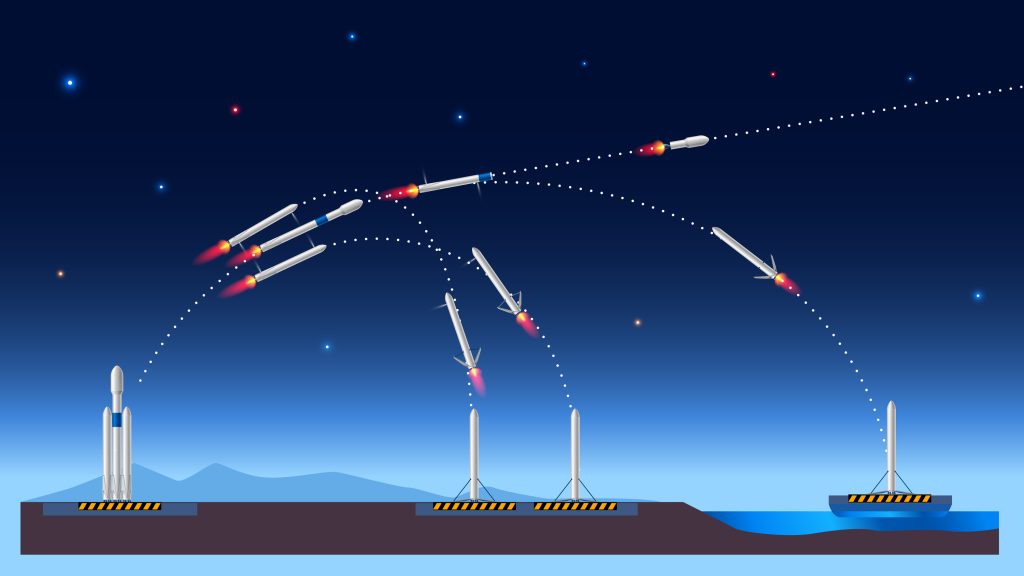
For decades, space activity was driven mainly by governments. It was expensive, slow, and limited to a small number of elite organizations. Today, that model has changed dramatically. Reusable launch systems have lowered costs. Private capital has entered the market. New satellite architectures have improved speed, flexibility, and coverage. Data from space has become more useful to more industries. At the same time, public-private partnerships have accelerated development in ways that were almost impossible a generation ago.
This matters because cost and access change everything. Once access improves, innovation follows. Once innovation scales, entirely new business models begin to emerge. That pattern has repeated itself throughout history. We saw it with computing, the internet, mobile platforms, cloud services, and AI. We are now seeing it in space.
The important point is this: space is no longer only a destination. It is becoming an enabling layer for life and commerce on Earth. That is what makes this moment so powerful. Businesses do not need to become rocket companies to benefit. They need to understand how space-based capabilities will reshape their industry and create new advantages for those who move first.
Why does SpaceTech matter far beyond aerospace?

One of the biggest misunderstandings about the commercial space frontier is the belief that it only matters to aerospace companies. I do not see it that way at all. I see SpaceTech as a cross-industry force multiplier. It will influence sectors that many leaders would never normally connect to orbit, launch vehicles, or lunar systems.
Think about what satellite-enabled services already support today. Precision agriculture depends on data. Supply chains depend on visibility and timing. Telecommunications depend on resilient networks. Financial markets depend on secure infrastructure and continuous connectivity. Emergency response depends on fast situational awareness. Insurance depends on risk modeling. Energy companies depend on remote monitoring. National security depends on better intelligence and communication systems.
That is why smart leaders should be asking a different question. Not “Are we in the space industry?” but “How will space-enabled capabilities change the way value is created in our industry?” Once you ask that question, the opportunity becomes far larger and far more strategic.
How does anticipation turn uncertainty into advantage?

I have spent decades helping organizations separate what can be known from what merely feels uncertain. Too many leaders treat the future as if it is one giant fog bank. It is not. Some parts of the future are uncertain, but other parts are highly predictable. I call those certainties Hard Trends. When you identify them correctly, you can use them to reduce risk, solve problems before they happen, and move ahead of the competition.
The commercial expansion of space is supported by several Hard Trends. Computing power keeps advancing. Sensors keep getting smaller and cheaper. Connectivity keeps improving. Private investment in frontier technologies continues to expand. Demand for better data, faster communications, and stronger infrastructure is increasing. Those are not random possibilities. They are directional certainties.
That is where the advantage begins. If leaders wait until the opportunity is obvious to everyone, they are already behind. The goal is not reckless action. The goal is confident action based on certainty. Anticipation allows you to innovate with lower risk because you are acting on what is already unfolding, not guessing at what might someday appear.
What opportunities are opening up right now?
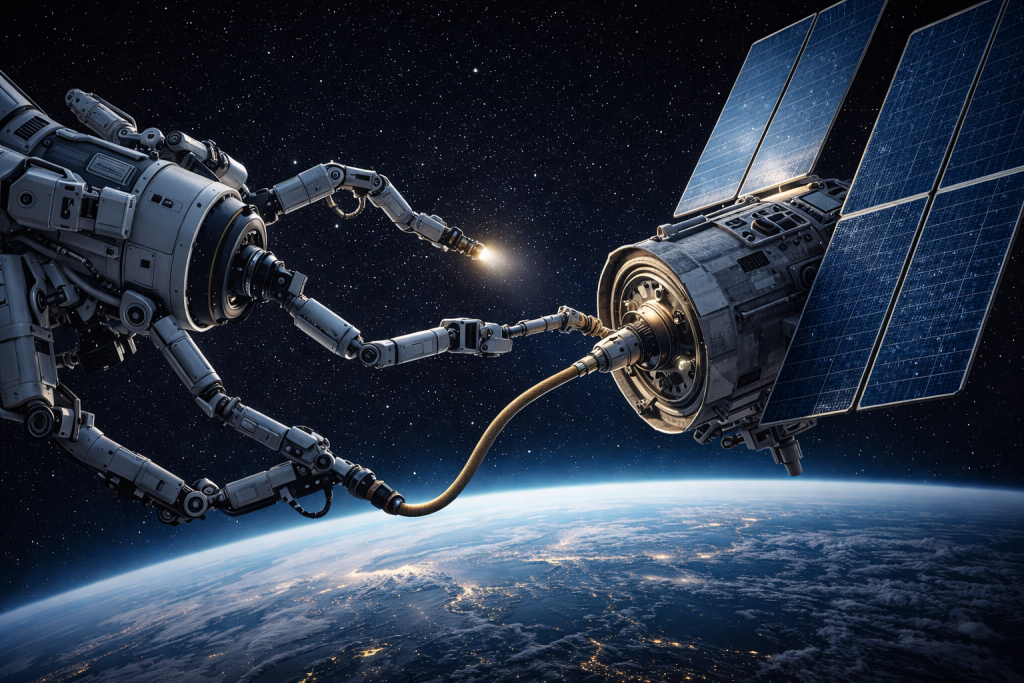
The commercial space economy is not one opportunity. It is a stack of opportunities. Some are highly visible, while others are hidden inside supporting technologies and services. That is why leaders need to look beyond headlines and examine the full ecosystem that is taking shape.
Here are a few of the major areas where I see momentum building:
- Satellite services and data platforms are expanding how businesses gather intelligence, monitor assets, and improve decision-making.
- Launch innovation is reducing barriers to access and enabling more frequent deployment of commercial systems.
- In-orbit servicing and infrastructure are creating new possibilities for maintenance, extension, repair, and optimization.
- Lunar and deep-space development are pushing advances in robotics, materials, energy, autonomy, and remote operations.
- Earth-based spinoffs are turning space-driven breakthroughs into commercial tools used across many industries.
What makes these opportunities important is that they are interconnected. A breakthrough in launch economics supports satellite deployment. Better satellites improve data services. Better data services improve decision-making across industries. This is how platforms scale. This is how markets compound.
Why is timing more important than perfection?
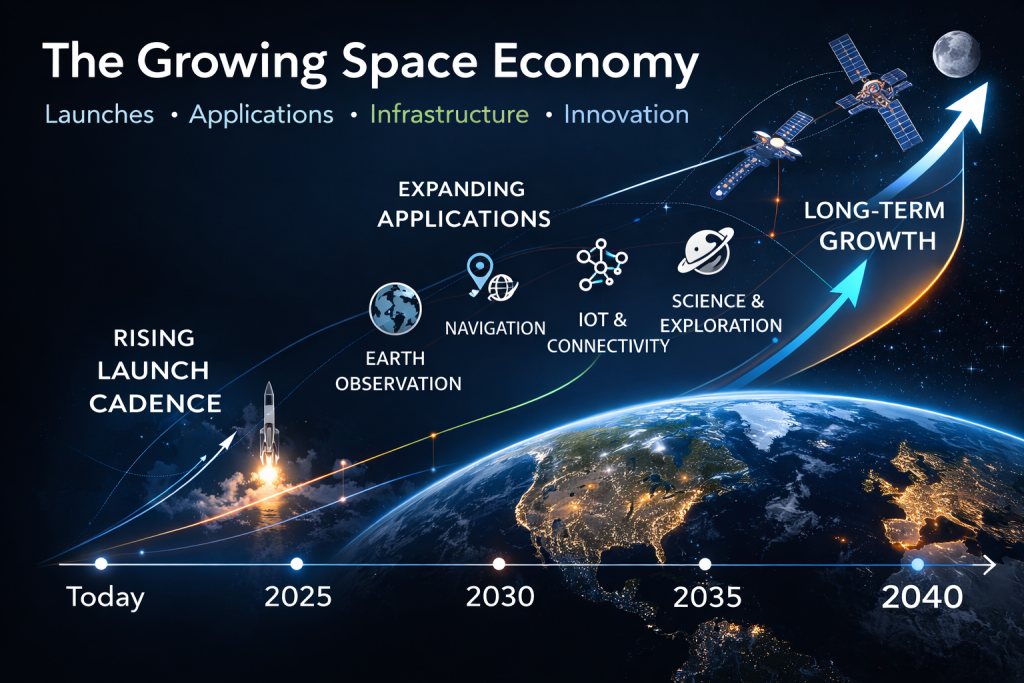
I often remind clients that transformation rarely rewards the most cautious observer. It rewards the leader who recognizes the pattern early enough to build capability before the rush begins. In the space economy, timing matters because the market is still taking shape. Standards, partnerships, supply networks, and competitive positions are not fully locked in yet. That creates an opening.
Too many companies think they need a perfect strategy before they begin. That mindset creates delay. In fast-emerging markets, delay is expensive. A better approach is to identify where certainty exists, make smart low-regret moves, and build optionality. In other words, do not wait until the entire path is illuminated.
Move decisively on the part that is clear. That could mean starting a strategic partnership. It could mean investing in internal capability. It could mean running pilot projects that connect satellite data to operations. It could mean rethinking product design, communications resilience, or remote asset management. What matters is that you begin learning while the field is still forming.
What should leaders be doing now to prepare?
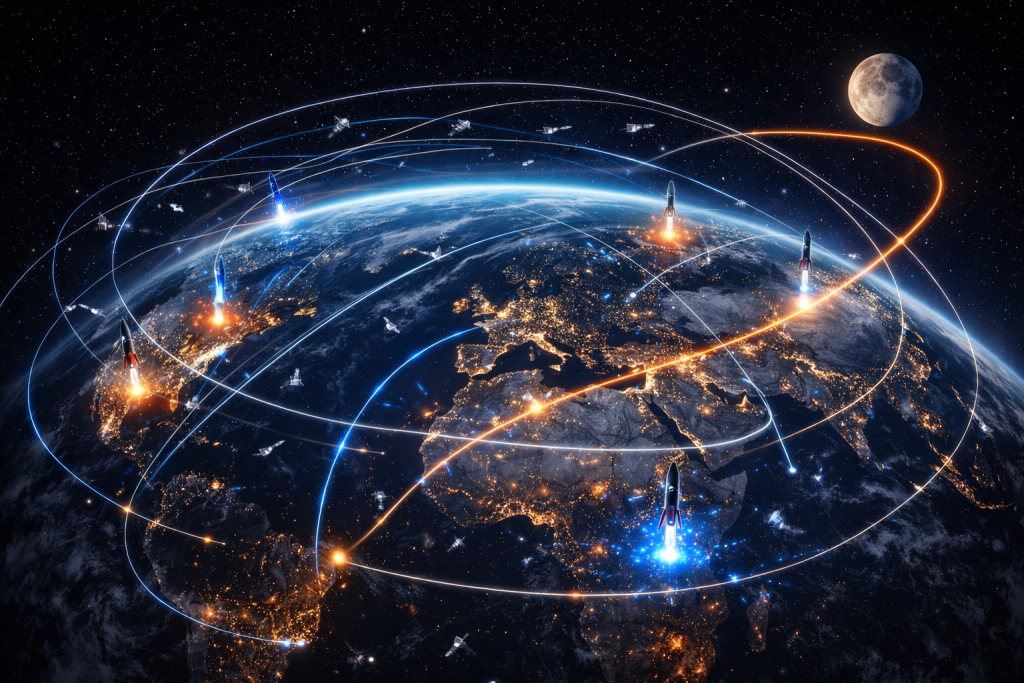
This is where leadership matters most. The future of space will not be shaped only by technologists. It will also be shaped by leaders who know how to translate emerging capability into business value. That starts by asking better questions and challenging outdated assumptions.
The first move is to stop treating SpaceTech as a niche topic. It belongs in strategic planning. It belongs in innovation discussions. It belongs in risk conversations. It belongs in long-range growth models. Once you bring it into those conversations, new possibilities begin to emerge.
The next move is to assess where space-enabled change could affect your organization first. For some companies, it will be connectivity. For others, it will be data, logistics, monitoring, security, or resilience. Still others will find opportunity in the supplier ecosystem, advanced materials, manufacturing support, robotics, or autonomous systems. You do not need to do everything. But you do need to know where your window is opening.

Subscribe to AlphaGamma!
Receive the latest articles, news, events, business & career opportunities to your inbox!
How can organizations avoid reacting too late?

The organizations that struggle most during periods of transformation usually share the same habit: they wait for certainty that is visible to everyone else. By then, margins are tighter, competition is stronger, and the easy advantages are gone. That is reactive leadership, and it is costly.
Proactive leadership looks different. It builds understanding before urgency arrives. It develops relationships before they are needed. It creates small experiments before disruption forces larger change. That is the real value of anticipatory thinking. You do not need to predict every detail of the future. You need to identify the forces that are already shaping the future and take action while choice is still abundant.
Here are practical ways to avoid falling behind:
- Build a cross-functional team to track how space-enabled technologies affect your business model.
- Identify one or two areas where small pilots can generate insight quickly.
- Watch for adjacent opportunities, not just direct ones, because some of the best gains come from second-order effects.
- Revisit your strategic assumptions about infrastructure, connectivity, monitoring, and resilience.
Those steps may seem simple, but they create momentum. And momentum matters when a market is moving from possibility to reality.
What does the commercial frontier teach us about innovation itself?

One of the reasons I find this moment so exciting is that it reminds us of what innovation really is. Innovation is not just invention. It is the application of change to create value. That means the most successful companies in the space economy may not be the ones with the flashiest hardware. They may be the ones that connect capability to customer need in a way others miss.
That is why business leaders should not get distracted by spectacle alone. Launches matter. Missions matter. Technology matters. But the bigger question is how those advances will solve problems, unlock efficiencies, open markets, and create scalable advantage. The future belongs to the organizations that can translate technical change into practical value.
This has happened before in every major wave of transformation. Many people admired the technology. Fewer understood the business model. The real winners were the ones who turned emerging capability into repeatable value. SpaceTech is following that same pattern now.
Why is this moment bigger than a trend?

A trend can be temporary. A platform shift changes the game. What I see in the commercial space frontier is not a passing burst of excitement. It is a foundational expansion of capability that will continue to influence how the world operates. The infrastructure being built today will support services, industries, and business models that become far more visible over time.
That is why I urge leaders not to frame space as a novelty. Frame it as a strategic layer. The companies that understand this earliest will have a better chance to shape standards, form partnerships, build expertise, and capture outsized returns. The companies that dismiss it may eventually participate, but they will do so on someone else’s terms.
The future does not reward passive awareness. It rewards informed action. That is especially true when a market is crossing from experimental to essential.
What bold move will separate tomorrow’s winners from everyone else?

The biggest lesson of the new space economy is not about rockets. It is about leadership. It is about whether you can see opportunity before it becomes crowded. It is about whether you can use certainty to move with confidence while others remain hesitant. It is about whether you will lead transformation or wait to be forced into it.
I believe the commercial space frontier is opening one of the most important opportunity windows of our time. Not because every company will go to space, but because space-enabled capability will increasingly shape competition on Earth. Leaders who understand that now can build the future rather than react to it later.
So this is the question I would leave you with: what would change in your strategy if you stopped viewing space as a distant domain and started viewing it as an immediate business advantage? That is where the real opportunity begins. And that is where bold leaders will start making their move.
To learn more about how I help organizations anticipate disruption, harness Hard Trends, and turn uncertainty into opportunity, visit www.burrus.com.
For more life-changing opportunities and tips on entrepreneurship and finance, subscribe to our weekly newsletter and follow us on X, Facebook, Instagram, and LinkedIn.